
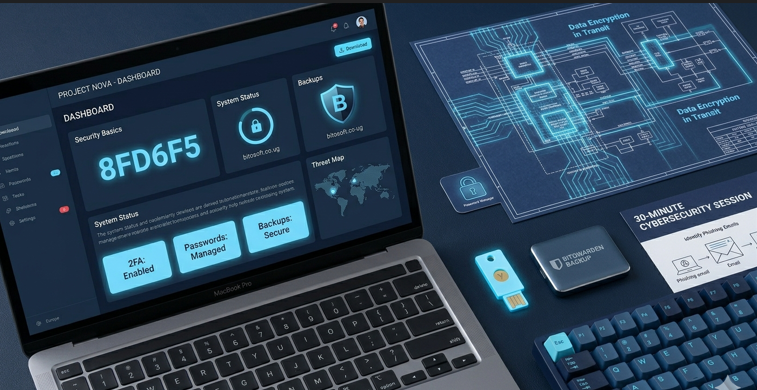
In 2023, Uganda's National Information Technology Authority reported a 300% increase in reported cybersecurity incidents over the previous year. The majority of victims were not large corporations — they were small businesses, schools, and NGOs that assumed they were too small to be targeted.
That assumption is now dangerous.
Why SMEs Are Targeted
Attackers follow the path of least resistance. Large enterprises invest in security teams, firewalls, and incident response. SMEs typically have none of these. The same attack that would be blocked in seconds at a telecoms company can run undetected for months at a small business.
Common attack vectors we see in Uganda:
- Phishing emails impersonating banks, URA, or mobile money providers
- Weak passwords on shared business email accounts
- Unpatched software — using Windows XP or unupdated Android apps
- No backups — ransomware is devastating when there is no recovery path
The Five Things You Should Do This Week
1. Enable Two-Factor Authentication (2FA)
Every email account and financial service should require a second verification step. Use an authenticator app (Google Authenticator or Authy) rather than SMS where possible.
2. Use a Password Manager
If your staff share passwords written on sticky notes, you have a problem. A password manager like Bitwarden (free for individuals and small teams) stores unique, strong passwords for every service.
3. Back Up Your Data — Off-Site
The 3-2-1 rule: 3 copies of your data, on 2 different media, with 1 off-site. For most SMEs, this means: local copy + external drive + Google Drive or similar cloud backup.
4. Keep Software Updated
Enable automatic updates on all phones and computers. Yes, this means restarting occasionally. No, there is no good reason to keep running Windows 7.
5. Train Your Team
The most sophisticated firewall cannot stop an employee who clicks a malicious link. Run a 30-minute session with your team on how to identify phishing emails. Show real examples. Do it every six months.
What Bitosoft Builds In
All Bitosoft products include:
- Encrypted data storage — data at rest is encrypted
- HTTPS only — all communication is encrypted in transit
- Role-based access — staff only see data they need
- Audit logs — every significant action is recorded
- Automatic backups — daily snapshots with 30-day retention
We cannot secure your whole business — but we can ensure our software is not the weakest link.
Getting Help
The National Information Technology Authority Uganda (NITA-U) offers cybersecurity resources for businesses. The Uganda Computer Emergency Response Team (UCERT) handles incident reporting.
If your business has been attacked or you suspect a breach, contact your software provider and UCERT immediately. The faster you act, the less damage.
---
Concerned about the security of your business software? Speak to our team about a security assessment.
Leave a Comment